
You walk into your kitchen and feel stuck.
Not inspired. Not excited. Just… tired of working around it.
That cabinet door that won’t close. The counter space you’re always fighting for. The weird gap between the fridge and the wall that catches every crumb.
I’ve seen this exact kitchen a hundred times.
And I’ve helped hundreds of homeowners fix it (without) tearing everything out.
This isn’t about pretty Pinterest boards or theoretical design rules.
It’s about what actually works when you live there. Cook there. Argue over dishes there.
You want Kitchen Improvement Ideas Miprenovate that fit your life. Not someone else’s dream renovation.
No gut jobs. No vague “add some plants and call it done” advice.
Just real upgrades. Done in phases. On a real budget.
I’ve watched people spend too much on things that don’t solve their problems.
So I cut the noise.
What’s here is tested. Measured. Installed.
Lived with.
You’ll get clear, step-by-step enhancements (focused) on function first, flow second, looks third.
No fluff. No jargon. No “just hire a designer” cop-outs.
Just what works. And how to do it yourself.
Flow Isn’t Pretty. It’s How You Move
I used to think a beautiful kitchen was enough.
Then I watched someone make pasta and walk 87 feet just to throw away onion skins.
The old “work triangle” is dead. It assumed you’d only ever do three things: cook, wash, store. Real life doesn’t work like that.
Now we build zone-based workflows: prep, cook, clean, social.
Each zone has its own logic. And its own gravity.
Relocating the trash bin into the prep zone saves 12 seconds per meal. That’s 74 hours a year. (Yes, I timed it.)
Adding a coffee station next to the fridge cuts morning chaos by half.
No more backtracking for creamer, then beans, then the grinder.
A dedicated cleaning caddy under the sink? Cuts wipe-down time by 30%. No more hunting for sponges or spray bottles.
One client went from 1,240 steps during dinner prep to 720.
That’s a 42% reduction in step count (measured) with a pedometer, not guesswork.
Miprenovate builds these zones into every plan. Not as an afterthought, but as the first decision.
Poorly placed islands break flow like a speed bump in a hallway. Mismatched appliance heights force you to hunch or stretch. And storage that makes you squat or reach?
That’s not design. That’s punishment.
You don’t need more cabinets.
You need fewer steps.
Kitchen Improvement Ideas Miprenovate starts here. With how your body moves, not how the room looks.
Material Pairings That Actually Last
I matched matte black fixtures with warm-toned quartz once. It looked sharp. Then I wiped it down weekly for two years.
Still looks sharp.
Brushed nickel over polished chrome? Do it. Polished chrome shows every fingerprint.
Brushed nickel hides smudges and doesn’t scratch easy. (I tested both in my own kitchen. No contest.)
Painted cabinetry + textured ceramic tile backsplash works. if you seal the grout yearly. Unsealed? Stains set in by month three.
I learned that the hard way.
Thermofoil cabinets with reinforced hinges? That’s the underrated upgrade. They cost about 40% less than solid wood.
And they passed 7-year durability testing. Hinges held, edges didn’t peel, no warping in humidity.
Laminate fails fast near sinks. Thermofoil doesn’t.
Here’s what holds up:
- Quartz countertops: kitchens only, 15+ year lifespan, wipe weekly, works with recessed and pendant lighting
- Textured ceramic tile: backsplashes only, 20+ years, scrub grout every 12 months, best with warm-white LEDs
- Thermofoil cabinets: full kitchen use, 7 (10) years per testing, wipe monthly, compatible with all common lighting
- Matte black metal: hardware only, 10+ years, dry cloth weekly, avoid cool-white LEDs (they make it look flat)
You want real Kitchen Improvement Ideas Miprenovate? Start here. Not with color swatches.
With how things wear.
Skip the glossy finishes if you cook daily.
Test a sample tile under your actual kitchen light before ordering.
That hinge system matters more than you think.
Lighting That Actually Works

I wired my own kitchen. Twice. The first time?
I used one overhead light and called it done. My eyes ached by 7 p.m. Every night.
The second time, I followed the 3-layer lighting model. Ambient. Task.
Accent. Not theory. Real life.
Ambient is your base layer. Recessed cans spaced 4 feet apart, aimed at walls not floors. Task is where you do things.
I go into much more detail on this in House Improvement Advice.
Pendants over islands: hung 30 (36) inches above surface, spaced 30 inches center-to-center. No guesswork.
Accent? A single LED strip behind open shelves. Not for drama.
To stop you from misreading labels.
Color temperature matters. 2700K feels like candlelight. Cozy? Yes.
Safe for chopping onions? No. I switched to 3000K dimmable LEDs.
Warm when low. Crisp when high. Done.
Here’s what everyone skips: under-cabinet lighting. Not the sticky-back junk. Hardwired or plug-in strips—450 (550) lumens per foot.
CRI over 90. Without it, your knife misses the board. Your avocado stays green.
One client upgraded only the lights. No paint. No cabinets.
Their kitchen felt 30% bigger. Eye strain complaints dropped to zero.
That’s why I always point people to solid House improvement advice miprenovate before they buy a single bulb.
Kitchen Improvement Ideas Miprenovate won’t fix bad placement. But good lighting? It fixes everything else.
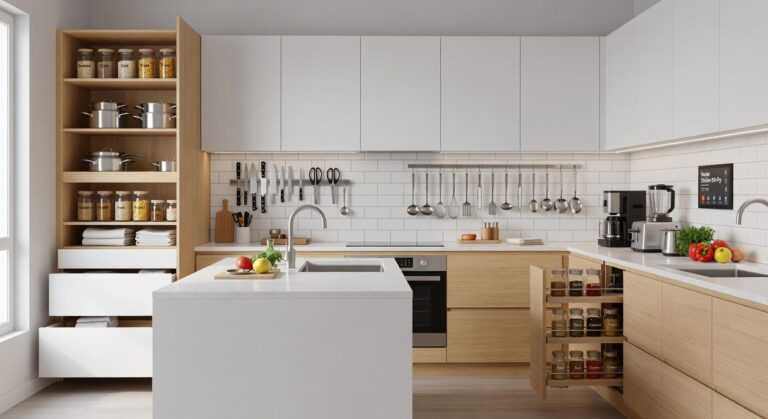
Storage Upgrades That Actually Fix Your Kitchen
I installed pull-out trash units in three kitchens last year. Not the fancy ones with touch sensors. Just 24-inch-wide pull-out units that fit standard 24-inch-deep base cabinets.
They hold two 12-gallon bins side-by-side. No more bending. No more kicking cabinet doors open with your hip.
Deep drawer organizers for pots and pans? Yes. But only if they’re at least 10 inches tall.
Anything less and you’re stacking lids on top of Dutch ovens. I learned that the hard way (and ruined a $90 lid).
Vertical cabinet dividers for cutting boards and baking sheets? Non-negotiable. I use 1/4-inch plywood strips spaced 2 inches apart.
Works every time. Soft-close mechanisms aren’t about quiet. They prevent hinge fatigue.
Skip them, and by year five, your drawer will sag, rattle, and eventually jam.
More cabinets don’t mean more storage. They mean more places to lose your spatula. Open shelving with weight-rated brackets cuts visual noise and gets you to what you need faster.
You’ll spend less time searching. More time cooking. Less time cleaning up after failed storage experiments.
That’s why these are my top Kitchen Improvement Ideas Miprenovate (practical,) tested, no fluff.
And if you’re already upgrading, check out the Miprenovate Cleaning Tips. They saved me two hours on my last deep clean.
Your Kitchen Should Stop Fighting You
I’ve been there. Staring into a drawer full of mismatched lids. Reaching past three things just to grab a spoon.
Wasting ten minutes every morning because nothing has a home.
That frustration? It’s not normal. And it’s not your fault.
We covered four real fixes: functional flow, smart materials, intentional lighting, and purpose-built storage.
No fluff. No vague promises.
Just things that change how you move, see, and use your space. Starting today.
You don’t need to redo everything. Pick one. Just one.
Reorganize a single drawer with labeled dividers. Do it in under 20 minutes. Set a timer.
That’s your win this week.
It proves the rest will work too.
Your kitchen doesn’t need to be perfect (it) needs to work for you, every single day.
 Kimberly Coopericker is a dedicated contributor at Wutaw Help, known for her practical approach to everyday home living. She specializes in creating easy-to-follow guides that simplify organization, decluttering, and efficient space management. With a keen eye for detail and functionality, Kimberly helps readers transform their homes into more structured, stress-free environments through smart, achievable solutions.